- Sep 13
How much to save before quitting your job
The usual answer is three to six months of expenses. That sentence does not know your rent, your kids, or whether you already have an offer.
How much you should save before quitting your job is not a slogan. It is months of runway: cash you can touch this week, divided by the bills that do not stop if the paycheck does.
If you have no offer, use the long end of the range. Not the headline.
The formula
Months = cash you can use in 7 days ÷ (must-pay − income that continues).
Cash is checking and savings. Not a 401(k). Not the house. Not a bonus that has not landed.
Must-pay is rent or mortgage, basic food, insurance, debt minimums, children, and health cover you would have to buy yourself. Not restaurants the salary made normal.
Income that continues is only money that would still arrive if you quit tomorrow. If you are not sure, write $0.
Want a cushion? Multiply must-pay by 1.15 before you divide. That is burn. The bottom of the fraction is the monthly hole.
A worked example
Must-pay is $3,200.
They want the 15% cushion: $3,200 × 1.15 = $3,680.
Cash they can take out this week: $12,000.
Income if they quit tomorrow: $0.
Hole: $3,680.
Runway: $12,000 ÷ $3,680 ≈ 3.3 months.
3.3 is under 6. The rule is stay. They need about $22,100 for 6 months, $33,100 for 9, $44,200 for 12. They can hate Sunday and still be right not to resign this month.
Put your own numbers in the leave-or-stay sheet. It is free.
How much depends on what you are leaving toward
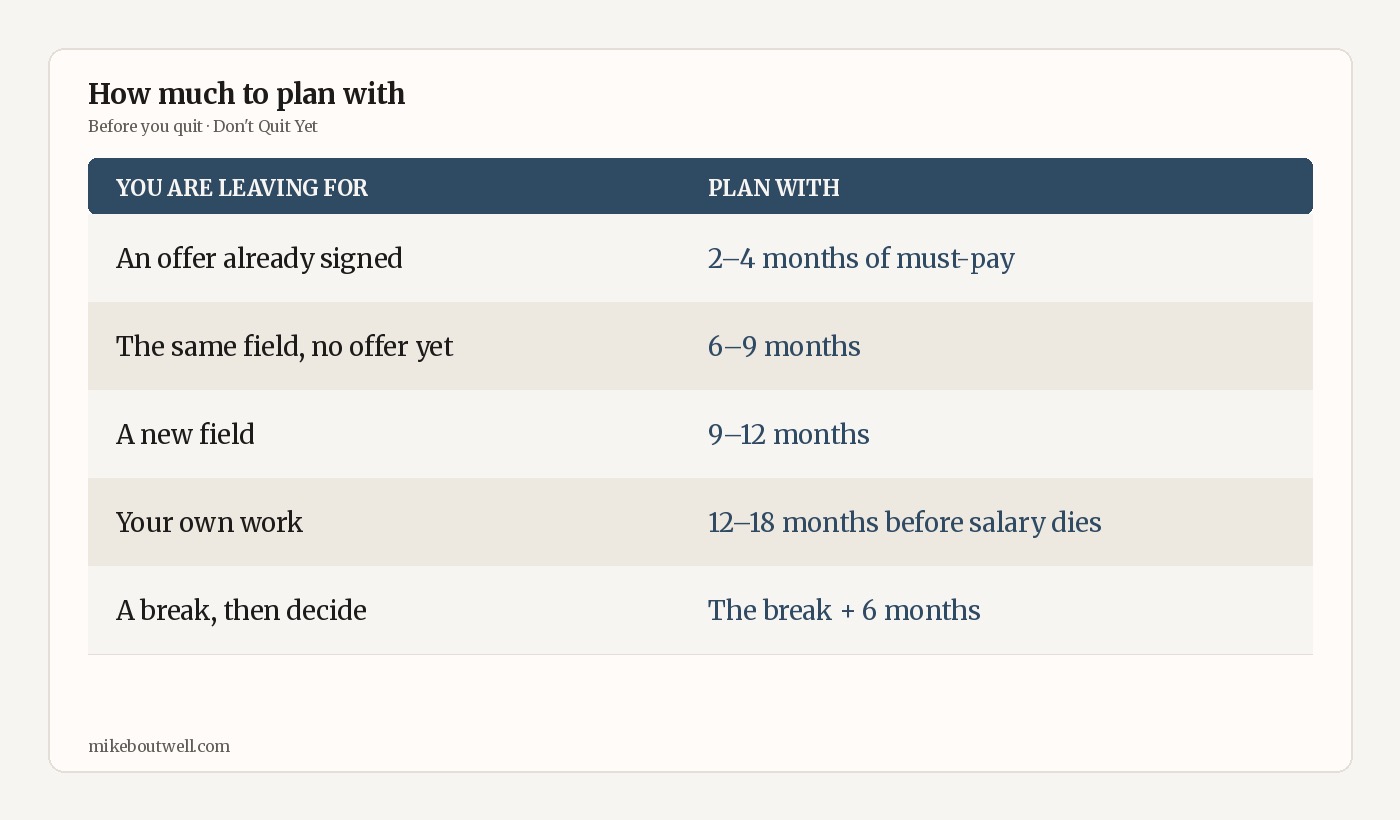
If someone depends on this paycheck, or health costs jump when you leave, use the longer number.
“Six months” is enough for some people. It is not enough if the next chapter is a new field or a business that does not pay yet.
The rule after you have a number
Under 6 months: Do not quit. Reduce the week if you can. Build cash.
6–12 months: You may look. Do not jump until an offer covers must-pay.
12 months or more: You have time. A new field still takes months.
A short number is not a character flaw. It is a fact. The next job is to raise cash or cut must-pay — not to write a speech about purpose.
What this does not decide
Burnout can be real and the account can still be too thin. Both can be true. Leaving can help you get well. Leaving with 3 months of cash often adds a money emergency on top of the health one.
If you cannot get through the day, get help. In the US, call or text 988. This page is not medical advice and it is not an instruction to resign.
What to do this month
Open last month’s statements. Write must-pay. Do not guess.
Write cash you can use in 7 days.
Divide. Circle stay, look, or wait.
If the rule is stay, pick one money move (cut a bill, move cash you can touch) and one week move (a real night off the inbox).
Do not resign on the back of a slogan.
One essay, every Saturday morning
Real talk on money, burnout, and finding meaning after leaving the corporate world.